ÜGLY
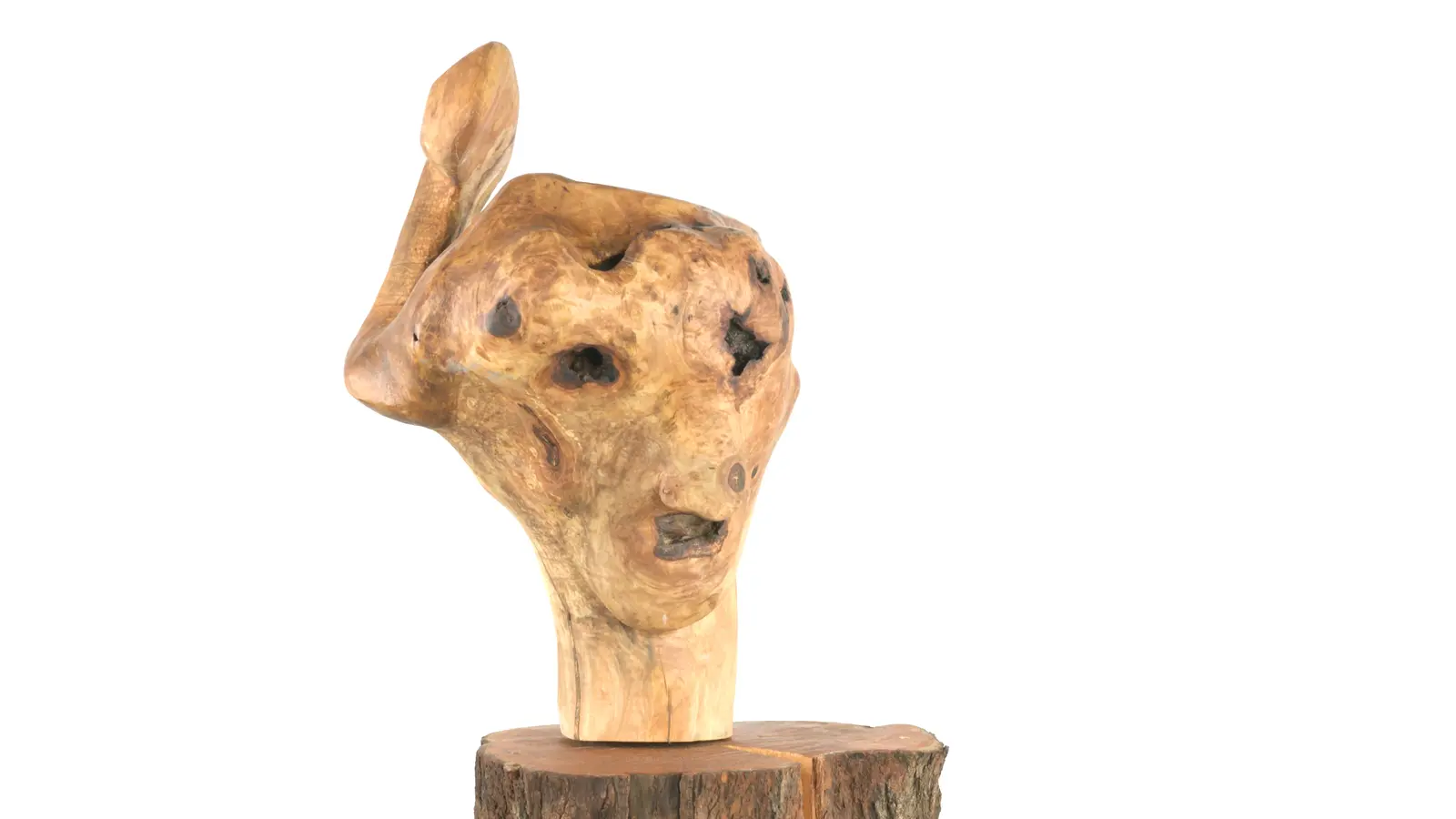
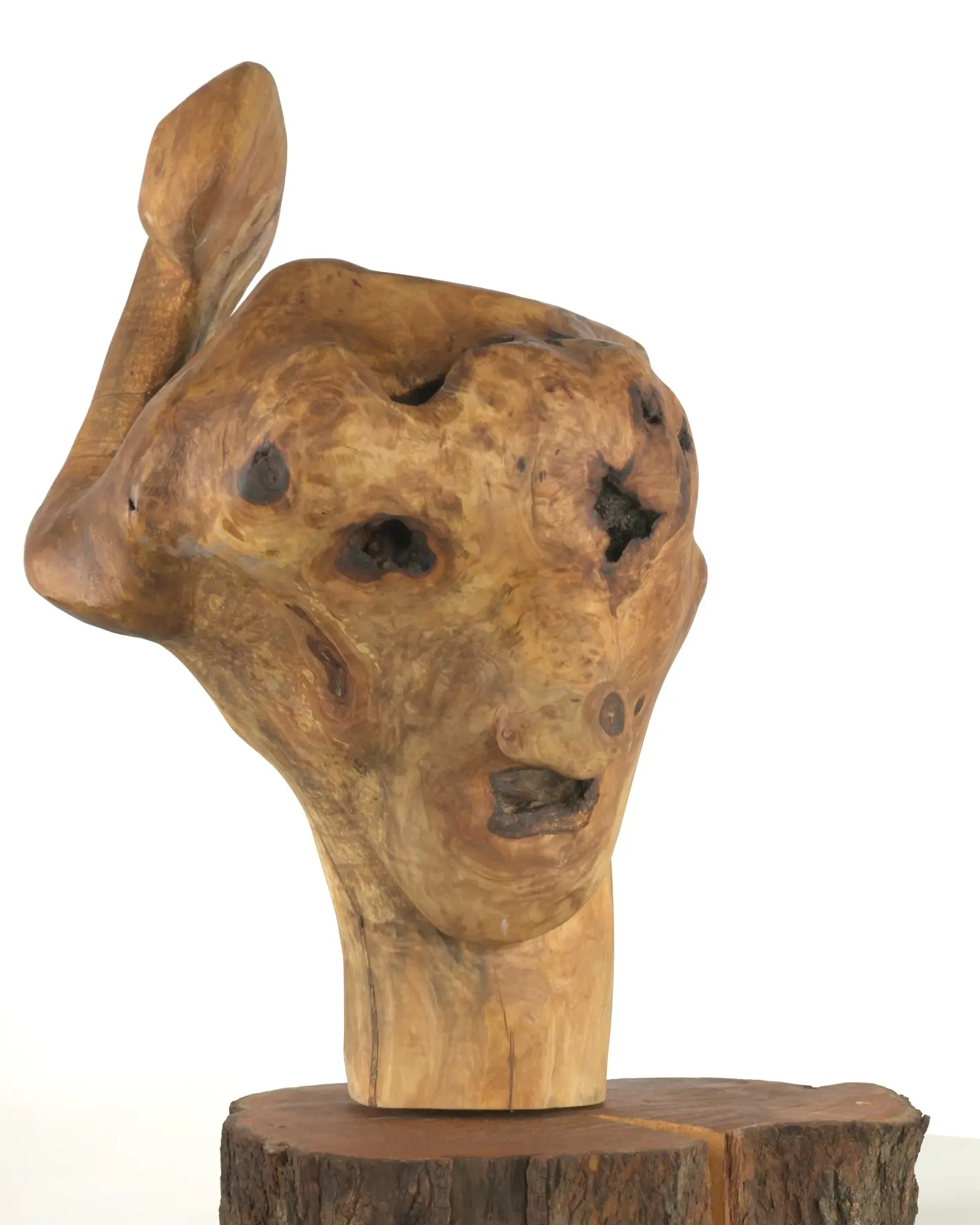
Brainless — carved wood head with expressive cavities, mounted on a bark-preserved log, light ground

Brainless

Man is a part of nature, even in his most degenerate and civilized form. A human being will always be a piece of nature. And it is for this reason that his modes of expression must also be at one with the way nature and matter expresses itself.
Asger Jorn, Naturalistic and Materialist Art

Robert Bibeau carved this head from a pale, honey-toned wood that holds a burl at its core, the dense region where the fibre coils on itself and gathers knots, dark inclusions, small cavities. The face surfaces out of that troubled grain. The eye sockets are two recessed hollows, one nearly circular, the other star-shaped. The mouth stays open, agape, cut low in the volume. Above it, a ridge of nose carries two small bored holes for nostrils. From the crown rises a curved element, a kind of horn or ear, hollowed out, breaking the symmetry one expects of a skull.

The piece is mounted on a section of log with its bark left intact. The neck, cut clean in the light wood, shows the marks of the saw before it rests on the rougher brown plinth; a visible joint separates the two. The base keeps its character as a billet of found wood, anchoring the head upright. It raises the figure without extending it, a raw presence beneath the polished face.

What the piece offers leans toward slow unease rather than fright. One looks at a face that seems to look back, from a span older than one's own. The burl, still legible under the skin of the wood, recalls that the figure was already latent in the swelling of the tree. A reservation remains: at certain angles the anthropomorphic reading dissolves and the head returns to a block, which may be its strength.
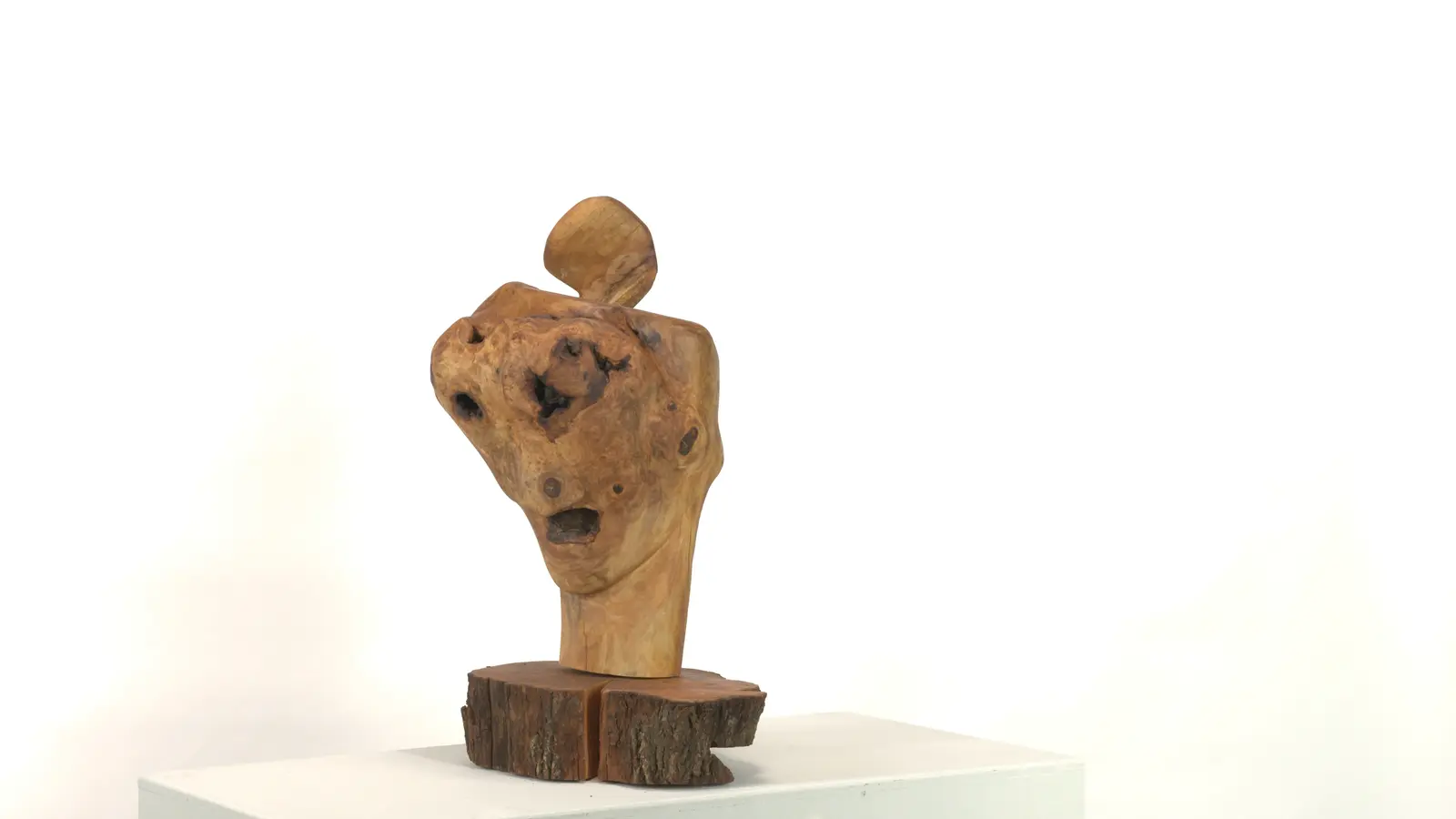
Brainless, work by Robert Bibeau
Studio view, white background.
Video
Reading notes

One possible reading: the head sits within a lineage of ritual objects where material precedes figure, where one recognises a face that was already there. Brâncuși sought the essential outline ; the gesture here is the inverse, keep everything, smooth nothing, trust the gaze to learn to see. The wood becomes a vocabulary: a form one returns to, independent of any copied repertoire.