ÜGLY
Untitled, work by Robert Bibeau

Untitled

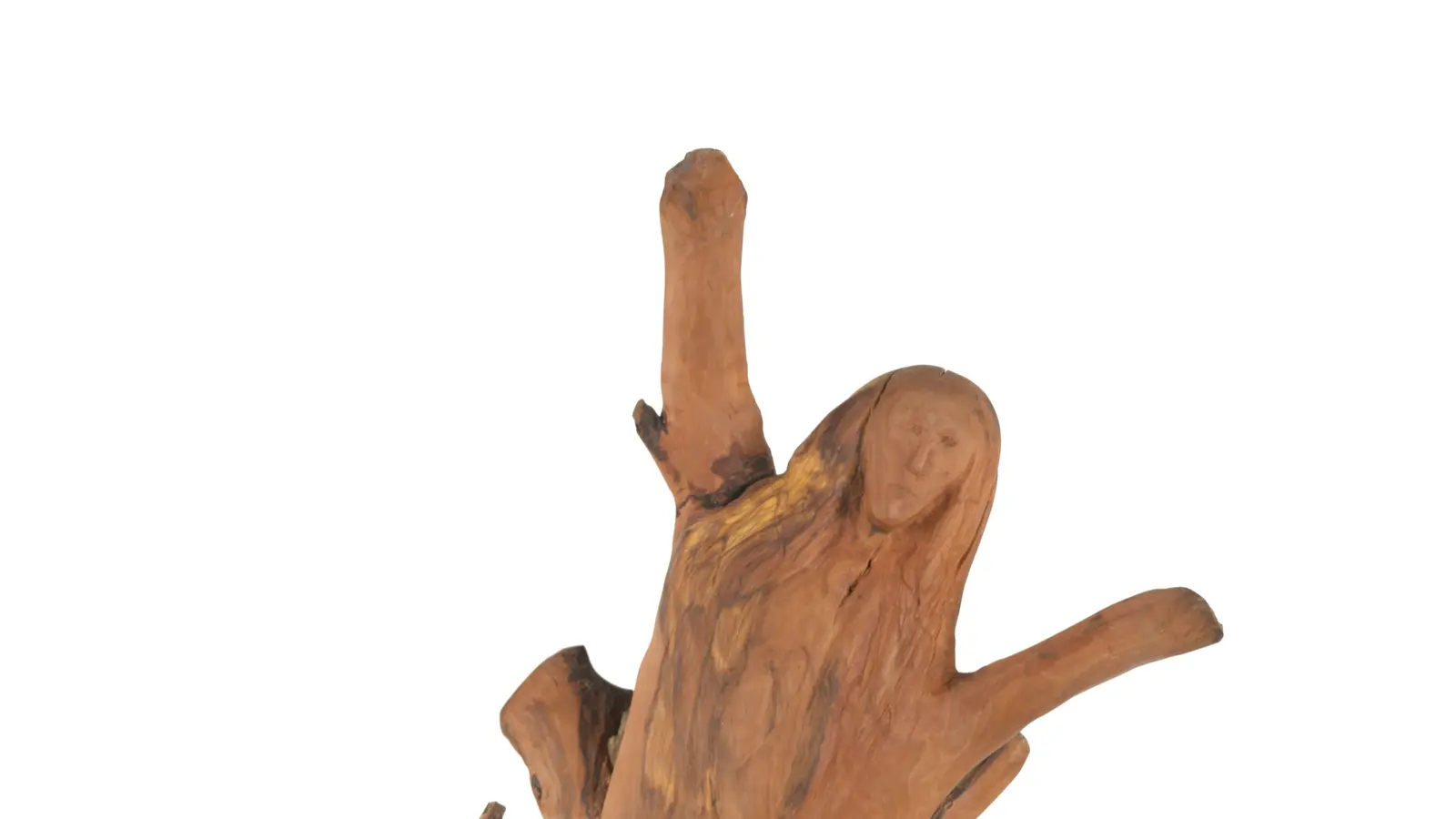
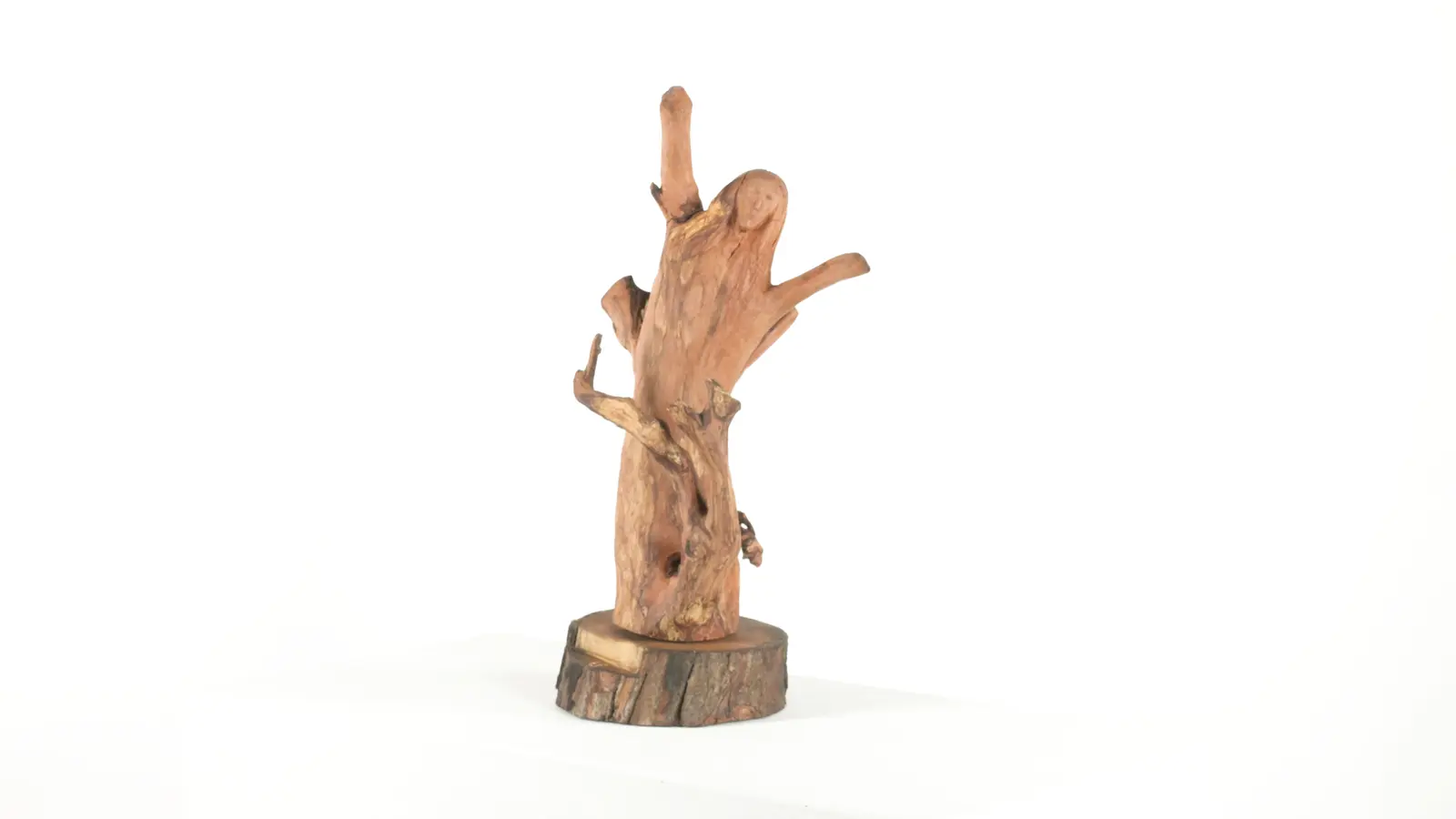
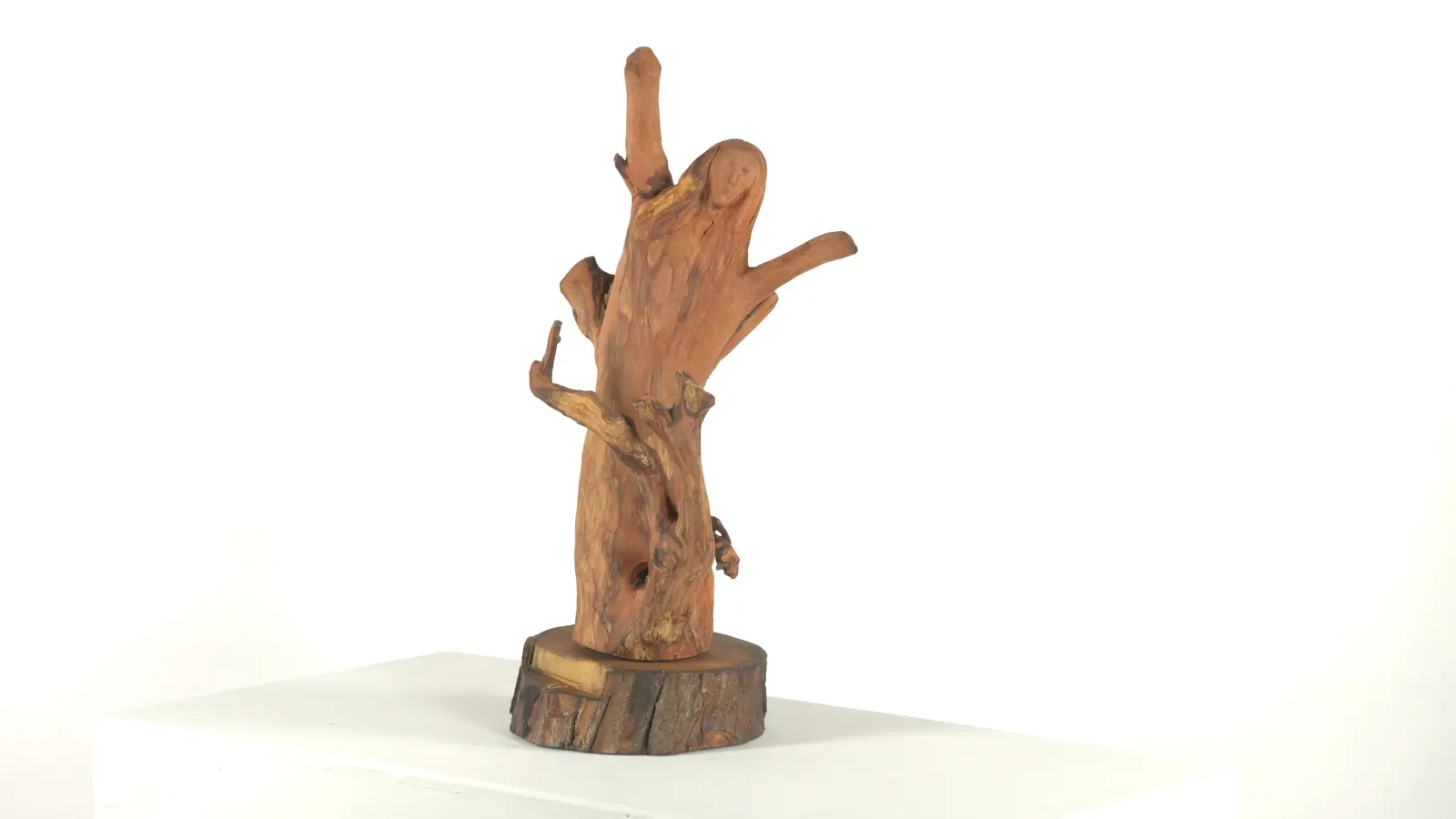
A vertical form of roughly sixty-seven centimetres, set upright on a log round whose bark still rings the edge. The wood is a warm reddish-brown, worked to a smooth finish across most of its height, with a few paler areas left in the sapwood. The branch keeps several stubs and the starts of limbs, including one arm that reaches off to the right and a folded shoot lower down. High on the shaft, a woman's face surfaces in the grain: calm features, lowered eyelids, a long smoothed fall of hair running down one flank like a veil. The gaze carries forward and slightly down. Nothing separates the figure from the wood; she rises out of its surface and stays held in it.

Robert Bibeau works by restrained subtraction. The cutting frees only what the face needs to appear and stops short of detachment, so that woman and tree remain a single body. The change reads as caught mid-course, at the moment one still hesitates over its direction: flesh turning to wood, or wood climbing back toward flesh. The limbs branching off the trunk extend that hesitation, poised between arms and boughs.

The image recalls the figure of Daphne, the nymph whose flight turns her to laurel under Apollo's hand. Here the scene has shed its terror. The face does not struggle; it looks out, settled, almost gathered into itself. The metamorphosis the work proposes leans toward rest rather than dread, a held pause in the passage from one form to another.

Untitled, work by Robert Bibeau
Studio view, white background.
Video
Reading notes

The piece converses with Bernini, whose marble *Daphne* in the Villa Borghese (1622-1625) remains the Western archetype of sculpted metamorphosis, living matter caught in the act of becoming another. Robert Bibeau substitutes for baroque virtuosity the sobriety of direct carving and keeps the wood rather than aspiring to marble. The kinship extends to the *Naturgeister* of Caspar David Friedrich's German Romanticism, peopling forests with spirits whose faces surfaced from the bark. And further still, to contemporary animist thought as theorised by Philippe Descola since the 2000s: the idea that the realms, human, animal, vegetal, communicate beyond their apparent boundaries.